
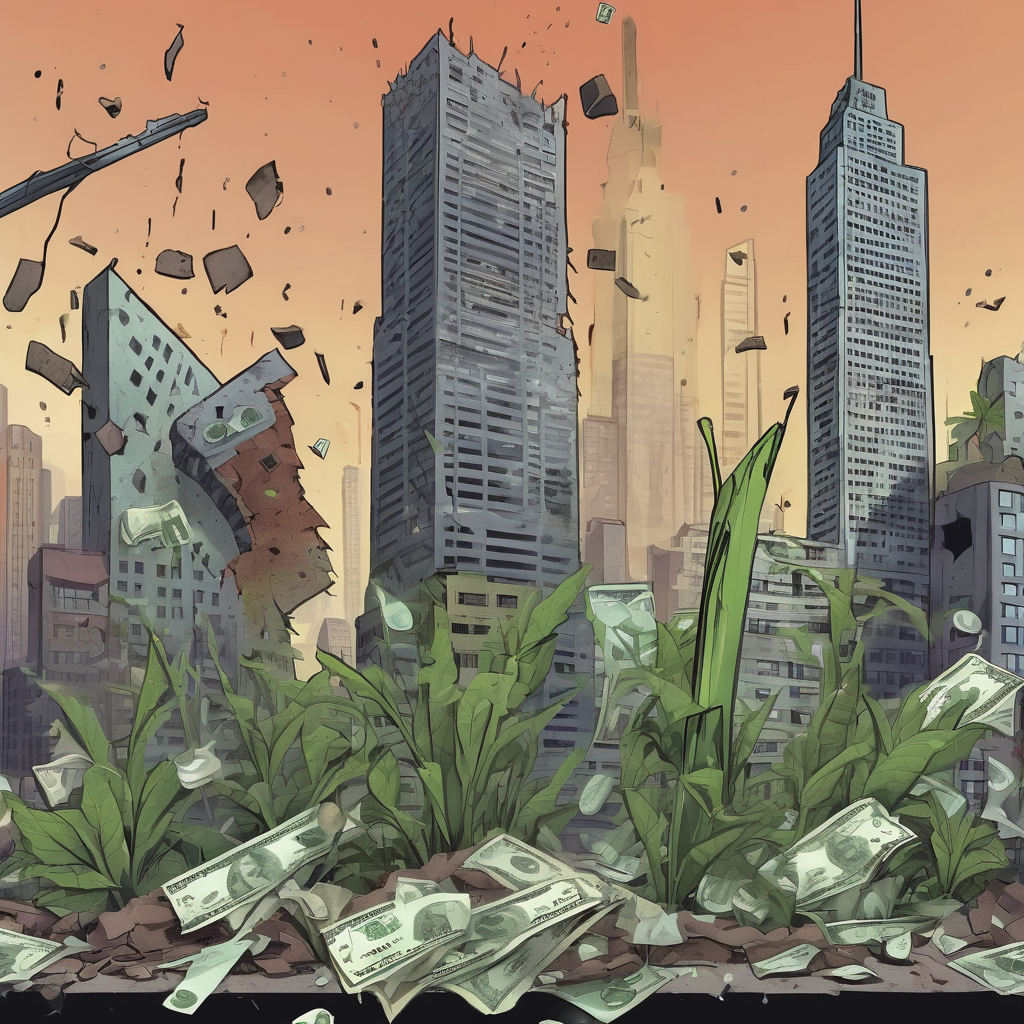
We are so used to living in an organized society that we assume if one day, we are broken out of it, we will eventually form one ourselves. This was the theme of media like Lord of the Flies and Lost. But after thousands of years of experiment, we still have not settled on the optimal way to organize a society? As we will see in this article, we don’t even know the answer to a smaller question of how to organize economic activities (as opposed to political activities) in a society?
Most modern economy is a modified variant of market economy, where money plays a vital role in determining who gets access to do what using what resources. Another name for this type of economy is “capitalism”. Modern economic theory is built on the concepts in a market economy, and do not work well outside of that scope (international trade may work quite differently in a cold war/world war).
Communism is another theory that suggests that capitalism both evil and flawed, and will eventually be replaced by a superior form of society where private property is abolished, along with governments and nations.
In this article, we will explore communist theory’s criticism of capitalism, and also how economics theory react to communist theory. Which version of each theory will we use to pit against each other? For communist theory, I will use the version learned from attending high school in China, and may not reflect the most authentic Marxist theory or the most modern version. For economics, I will use concepts in introductory Microeconomics and Macroeconomics, as those are the least controversial.
“Residual Value” vs. “Capital Income”
economic activities from a producer’s point of view can be described as follows: a private business purchases capital (rents a factory or office, purchases equipment, and hires workers to produce goods and services. The income generated from selling said goods and services is then shared between the government in terms of taxes, the workers in terms of wages, and the business owner in terms of capital gain. As we are studying the relationship between the workers and the capitalist, we will ignore the role of the government for now. The rest of the process can be divided into two parts: a production process in which the worker produces using the equipment, and a distribution process where the income is distributed between the worker and the capitalist.
In Economics, the production process is described using a production function P=f(l,c), where P is the quantity produced, l is the labor input and c is the capital input. Changing the number of workers hired, and (or) the equipment access, will affect productivity. On the distribution side, I=C+L, income is share between the worker (labor income) and the capitalist (capital income). One might notice if we add a tax component (reintroduce the government), it looks similar to the income approach to GDP, though here we are talking about an individual firm.
communists describes the same economic activity differently. In the production process, capital and equipment is called “tools of production”. A worker adds value to society by producing goods and services utilizing the tools. Note that in this narrative, the worker creates value, but not the tools. In the distribution process, the capitalist hands over part of the value the worker produced (our previous “labor income”), and keeps the rest for themselves (our previous “capital income”). Now this portion of income is called “residual value”. It’s no longer a reward for their part of the contribution, but an exploitation of the worker, who did all the real work in the first place.
One description is clearly more provocative than the other, which can be much more useful in inciting revolution.
Class Conflict
In the last section, we introduced the concept of “residual value”, which is used to criticize capitalism for being immoral. This section will introduce “class conflict”, which is used to claim that capitalism is unsustainable.
Communist theory states that ever since the introduction of private property, organized societies to date have been divided into two social classes, one oppressive, one oppressed. In a slave society, slavers oppress the slaves. In a feudal society, landlords oppress the peasants. In a capitalist society, capitalists oppress the workers.
Human history is summarized as a process in which a society promotes the advancement of productivity until it starts become a hinderance, then a new class rises from the oppressed, overthrows the existing society and introduces the next one.
For example, the slave society allowed humans to organize efforts and made mass projects possible. But slaves don’t have enough incentive to look after the increasingly expensive tools. So eventually, it was taken over by feudalism, where peasants were allowed keep some of their products so long as they satisfy a quota.
In terms of capitalism, it was theorized that the capitalists would suppress wages as much as possible, make workers work as hard as possible and increase prices as much as possible to keep as much residual value as possible. But that will eventually lead to a situation where workers can no longer afford goods and services, leading to economic downturns, and eventually a violent revolution where workers overthrow their oppressors.
But this theory cannot explain the workers’ welfare increase in reality. Communism seems to have underestimated the bargaining power of workers, i.e., their ability to push for social reforms without violence.
In addition, the concept of class conflict itself is fundamentally flawed. The theory relies on describing each class as if it were a decision making individual (agent) but in reality, each class is a collection individuals, all with their own incentives. A simple prisoner’s dilemma example demonstrates that, when multiple agents jointly make a decision, the outcome can differ from what a single agent would choose. For example, in a feudal society, kings own the most land. But kings have an interest to champion the cause of peasants against local landlords. Because for a king, those local landowning nobles are more of a threat than the peasants. In a capitalist society, business owners are willing to raise wages and worker welfare because competing firms, not their workers, are their biggest threat.
But the claim that capitalism being unsustainable is not completely without merit. The labor share of income (labor income as a percentage of total income) has been steadily decreasing. AI, an advancement that has the potential to dramatically boost productivity, is treated as a potential threat to be moderated. Complaints about the job market and a culture of “quiet quitting” seem to suggest that money’s role as a motivator is fading.
The Death of Capitalism
Scarcity is a basic assumption of economics. The need for resources exceed the availability, otherwise we wouldn’t need to worry about the distribution of resources that maximizes social welfare. Specifically, the need for human labor must exceed the people’s willingness to work, otherwise wages wouldn’t be needed to incentivize work. But what if this assumption no longer holds in modern society?
Technology improves capital faster than human labor, decreasing labor’s role in the production function. With the advancement of AI, perhaps one day labor can be dropped from the function entirely. When that day comes, if the society we live in remain as it is, what will happen to the people who need the income from a job? Even though the process will not be as communists describe, but they can easily summarize the situation as: productivity has improved so much that, capitalism become a hinderance than a facilitator, and the social structure becomes unsustainable.
With scarcity in place, capitalism uses distribution to incentivize production. But when labor is no longer needed in production, it solves a problem that no longer exists. Worse, it becomes a source of distribution problems (people can’t receive income due to jobs no longer available).
The end of a social structure will likely be chaotic and hard to predict. So let’s instead discuss a less complicated question: ignoring the process of change, when the dusts are settled, what kind of society can remain stable in a world without scarcity?
What Lies Ahead?
Karl Marx envisioned a society where nations, governments and private property no longer exist. To form a more concrete picture of such society, two movies come to mind: Matrix and Wall-E. Without scarcity, humans no longer need to directly interact. In both movies, humans live in an environment maintained by AI. Such a society is stripped of conflict of interest. Private property serves no function. And the society may be stable.
But one cannot predict future simply by proposing a possibility. One must also show that it is the only possibility. I am not aware of any such argument. In fact, valid or not, other proposals do exist. Take the behavior sink and universe 25 as an example. One takeaway is that, even if total resources no longer serve as a restricting factor, societies can still collapse. Recall that in addition to scarcity, another basic assumption economists make is that “people respond to incentives”. Changing environment can change behavior. Can the abundance affect us in such a way that we no longer have incentive to do what keeps the species going?
References and more related sources:
US labor share of income over time: https://fred.stlouisfed.org/graph/?g=1igtT
Leave a Reply